The complete picture
Build a more comprehensive genomic view of microbial pathogens
The advent of HiFi sequencing has radically increased the understanding of microbial genomics, pathogenicity, and antimicrobial resistance for public health and surveillance. PacBio sequencing systems deliver the most comprehensive genetic information available, and with HiFi sequencing, federal agencies, healthcare centers, and other public health organizations have the ability to:
- Generate complete genome assemblies and gain a deeper understanding of community-acquired and hospital associated infections and transmission.
- Use microbial epigenetics to further characterize global outbreaks, pandemics, and epidemics.
- Inform local and global preparedness and response to seasonal and annual infections by rapidly resolving viral populations.
- Characterize microbial communities with culture-free methods to support surveillance and tracking foodborne pathogens
Solutions Guide
A new standard in pathogen genomics
Detect, track, and characterize pathogens to a new standard of completeness and precision. PacBio solutions offer exceptional accuracy and long read lengths to support a wide range of pathogen surveillance applications.


Blog
THWART FOOD-BORNE CONTAMINANTS WITH THE UNMATCHED ACCURACY OF HIFI SEQUENCING
HiFi sequencing delivers the most accurate and comprehensive microbial sequence data possible to give food safety and public health professionals the clarity they need to better understand contaminants and make informed and timely decisions.
Blog
CUSTOMER SUCCESS STORY: HOW DR. IBRAHIM BITAR IS DOUBLING HIS RESEARCH IMPACT WHILE LEADING THE FUTURE OF EUROPEAN GENOMICS
When it comes to microbial genomics, Dr. Ibrahim Bitar doesn’t back down from a challenge. As an Assistant Professor of Microbiology at Charles University in Prague, and CEO of Gene Omics, a growing sequencing service provider in the Czech Republic, Dr. Bitar is on a mission to make high-quality, affordable long-read sequencing accessible across Central Europe.
With a Vega system powering research in his academic lab and a Revio system enabling cutting-edge services at Gene Omics, Dr. Bitar is a true champion of innovation, bringing PacBio HiFi sequencing to some of the most difficult-to-sequence samples, while empowering researchers throughout the region with the tools to transform their science.

Learn how other scientists have used SMRT Sequencing to advance public health:
- How HiFi sequencing achieves scalable microbial genomics without compromise
- Faster and more affordable sequencing with the HiFi microbial high-throughput workflow
- A living legacy of microbiology celebrates 100 years
- Keeping a close eye on MRSA: lessons learned from PacBio sequencing surveillance
- The antibiotic arms race: tracking K. pneumoniae in a hospital setting
- For pandemic surveillance, Labcorp scientists sequence thousands of SARS-CoV-2 samples with HiFi reads
- NARMS scientists track antibiotic resistance in foodborne bacteria using SMRT sequencing
- TB study finds some previously reported virulence variants were sequencing errors
- Scientists investigate minor influenza strains in pandemic, revealing new clues in flu transmission
Spotlight
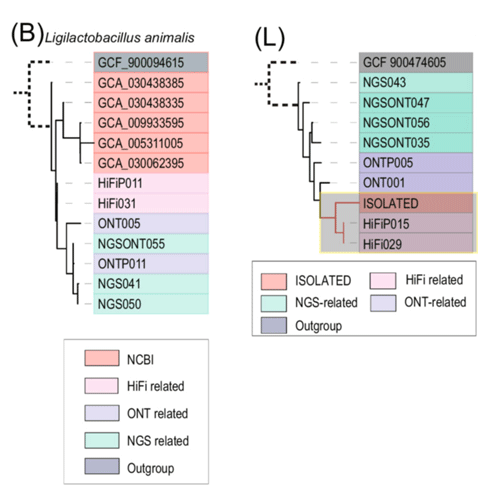
HIFI METAGENOME ASSEMBLY PROVIDES NEAR-ISOLATE QUALITY GENOMES, CULTURE-FREE
HiFi metagenome-assembled genomes (MAGs) cluster closest to reference genomes and isolate genomes from the same metagenome samples compared to short-read and other long-read technologies. HiFi metagenome assembly accuracy was nearly equivalent to isolate-based sequencing.
Deng, F., et. al., (2025) HiFi based metagenomic assembly strategy provides accuracy near isolated genome resolution in MAG assembly. iMetaOmics, e70041.

Figure 2B and 2L
View larger image


Spotlight
LONG READS SHED LIGHT ON THE SPREAD OF ANTIBIOTIC RESISTANCE IN FOOD SYSTEMS
Long-read sequencing of 134 multidrug-resistant Salmonella strains revealed important trends and details about the spread of AMR resistance in our food systems, including chromosomal integration of plasmids and the potential for co-selection of AMR genes in the presence of heavy metals used in food animal production.
Li,C. et. al. (2021) Long-read sequencing reveals evolution and acquisition of antimicrobial resistance and virulence genes in Salmonella enterica. Front Microbiol, 12, doi: 10.3389/fmicb.2021.777817